PUK-303
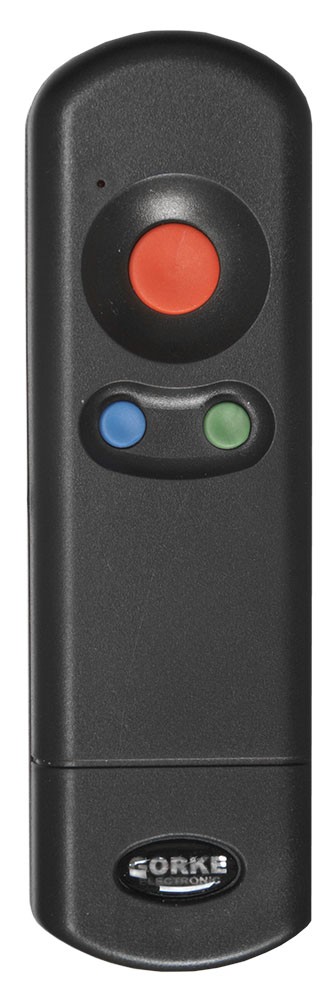
Driver’s remote control with the main key set in a recess: the first press reports arrival, the second “I’m in, you can close”. The model used in the installation, still available.
Quantity: 1 per driver
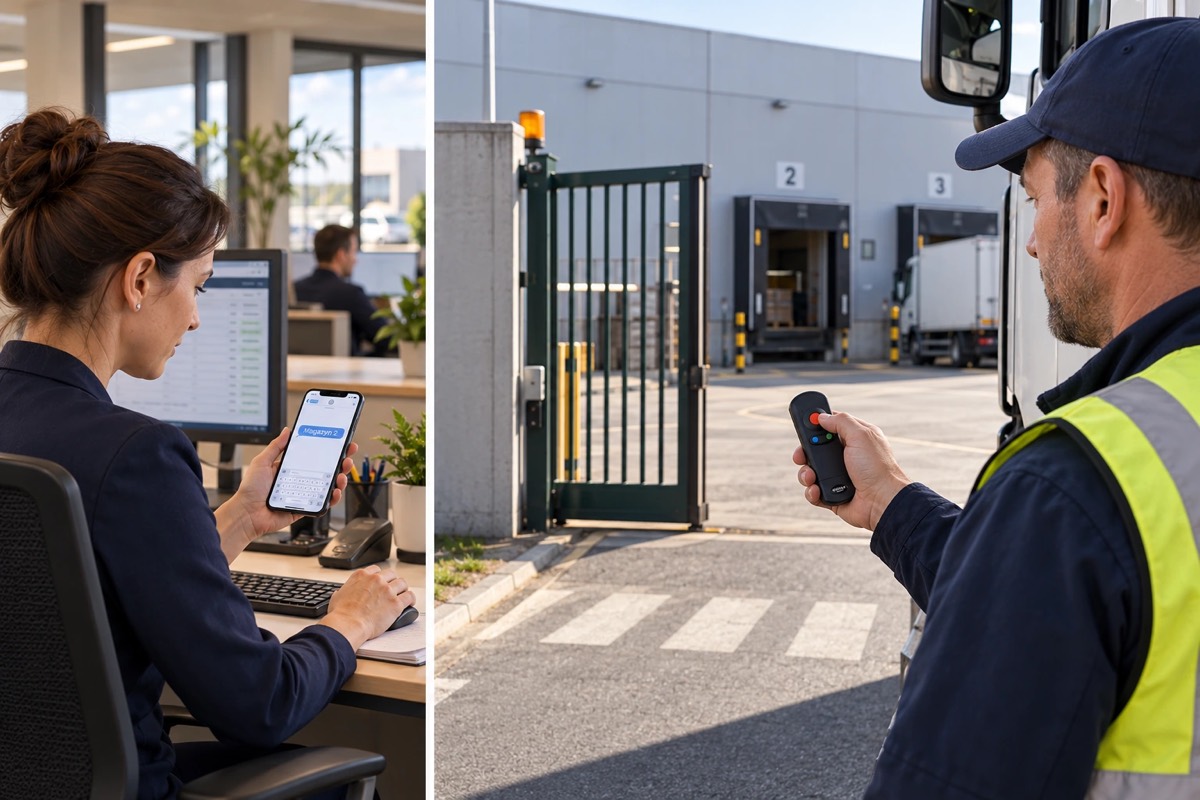
Control of the entry gates of two warehouses from the company’s head office, and recording of drivers’ arrival times: a remote control, a GSM transmitter at the warehouse and a gate controller that responds to a text or a CLIP call.
01 / Investment context
A logistics company with a fleet of several dozen vehicles has two warehouses 200 and 330 km from its head office. Drivers from that fleet arrive at both, and head office wanted to control the entry gates of both warehouses itself and to know what time each driver arrived.
A gate remote in every driver’s cab opens the gate without head office knowing and leaves no record of the arrival. Someone on site to open the gate is an extra cost at every warehouse. What was needed was a way for the driver to report arrival while head office decides on entry — even though hundreds of kilometres lie between them.
The investor’s goal: Control of entry to both warehouses from one place, regardless of distance, with each driver’s arrival time on record.
On arriving at the warehouse, the driver presses a key on the remote control (PUK-303). At the warehouse a GSM transmitter with a radio receiver picks up this signal and sends a text to the mobile phone of the supervisors at head office. Head office knows which gate to open and sends a text or a free CLIP call to the gate’s GSM controller — the controller triggers the drive’s control input and the gate opens.
Once inside, the driver presses the remote again: “I’m in, you can close.” The time of the arrival report stays in the text on the head-office phone. The installation used an ATG-SG2/RF transmitter and a GSU-B02 controller; in these roles GORKE today uses a GSM transmitter with a radio receiver (ATG-SG4RF), the successor to the ATG-SG2/RF, and an LTE GSM controller (GSU-K02/L).
02 / Operating principle
The driver reports arrival with the remote; head office receives a text and opens the warehouse gate itself by phone.
01 / Signal source
PUK-303 Driver’s remoteOn arriving at the warehouse, the driver presses a key on the remote.
02 / Transmission
ATG-SG4RF GSM transmitter at the warehouse gatePicks up the remote and sends a text to the supervisors’ phone at head office.
03 / Notification
Head office Supervisors’ mobile phoneKnows that a driver has arrived and which gate to open.
Head office knows the time of every arrival. The time of the report stays in the text, and once inside the driver signals again: “I’m in, you can close”.
01 / Signal source
Phone Supervisors at head officeSends a text or a free CLIP call to the gate controller.
02 / Reception
GSU-K02/L GSM gate controller, LTEOn a text or CLIP call from the head-office phone it triggers the drive’s control input.
03 / Action
Gate Warehouse entranceThe drive opens the gate and the driver can drive in.
The decision on entry stays with head office. The gate is opened by head office, not by a remote in the cab — 330 km away just as in its own yard, because mobile coverage is what counts.
A simplified functional diagram.
03 / Installation components
The models used in the project, with their equivalents in the current range.
Driver’s remote control with the main key set in a recess: the first press reports arrival, the second “I’m in, you can close”. The model used in the installation, still available.
Quantity: 1 per driver
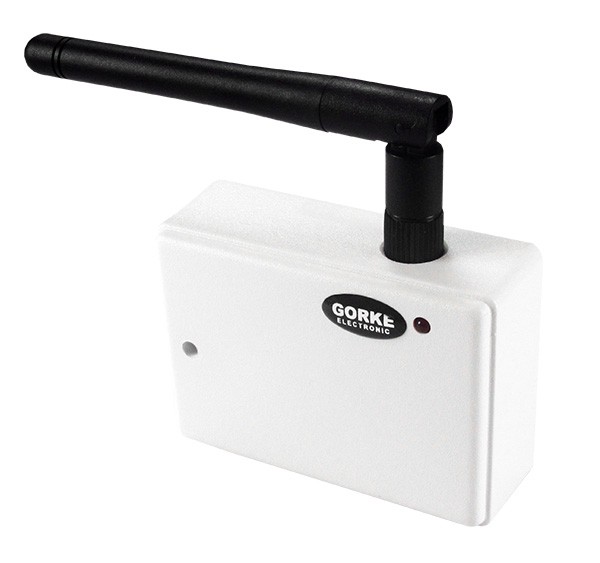
GSM transmitter with a radio receiver at the warehouse gate: picks up the driver’s remote and sends a text to head office. Successor to the ATG-SG2/RF model used in the installation.
Quantity: 1 per warehouse
GSM gate controller, LTE: on a text or a free CLIP call from the head-office phone it triggers the drive’s control input. Today’s equivalent of the GSU-B02 model used in the installation.
Quantity: 1 per gate
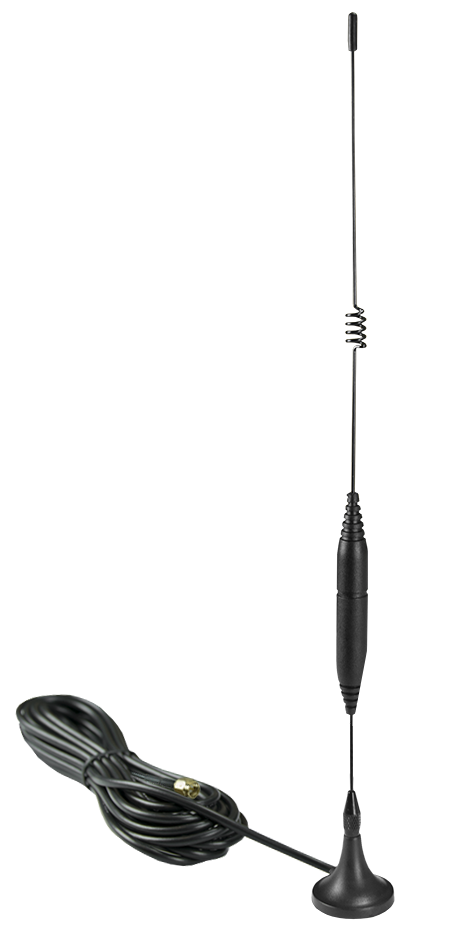
5 dBi GSM antenna on a magnetic base, where coverage at the warehouse gate is too weak for the antenna supplied with the device.
Quantity: optional
Catalogue figures describe a device under stated conditions, usually in open terrain, and are not a guaranteed range in every installation. Device quantities in the examples are indicative.
04 / Value for the investor
What counts is mobile coverage, not radio range: head office controls a gate 330 km away just as it would one in its own yard, and each further branch is just another pair of devices.
The time of every arrival report stays in the texts at head office, so nobody has to phone the drivers to find out when they arrived.
The gate is opened by head office, not by a remote in the cab: the driver reports arrival, but the decision on entry stays with head office.
05 / Before installation
Before devices are chosen, what matters is the site’s conditions and how the system ties into the final installation.
Source: an archived GORKE description of the installation. For a new investment we choose current models.
More from this sector
Logistics and transport
Filling stations, loading centres, transit warehouses: the night-shift worker confirms presence at intervals, and the supervision point sees whether the confirmations arrive on time.
Logistics and transport
A shipowner: a person at the ship’s entrance presses a button, the call runs by cable through the metal hull to every level, and from there by radio to the duty officers’ pagers.
Logistics and transport
A distribution centre with 24 loading docks: a button at the dock calls a forklift operator, and the dispatch office and pagers show the dock number — no two-way radio, no follow-up questions.
A project for your site
Send us the key requirements — GORKE will help define the scope, the technology and the components that fit the investment.