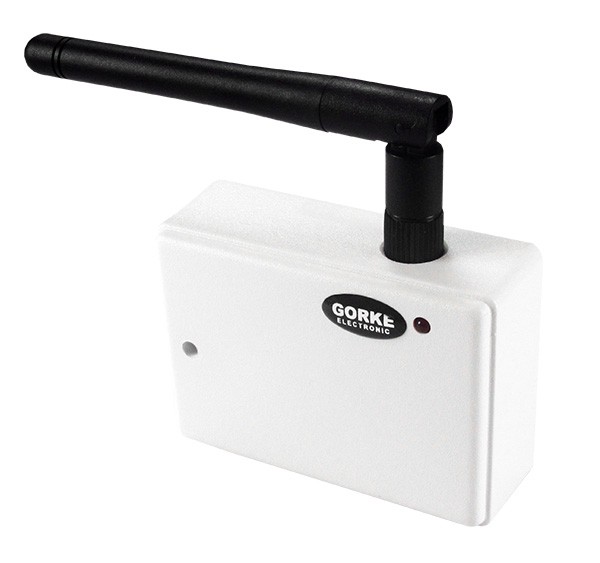
GSU-K02/L
GSM controller at the lamp — today’s LTE version of the GSU-K02 used in this project. Two channels, LTE: the output drives a contactor in the lamp’s supply circuit.
Quantity: 1 per lamp
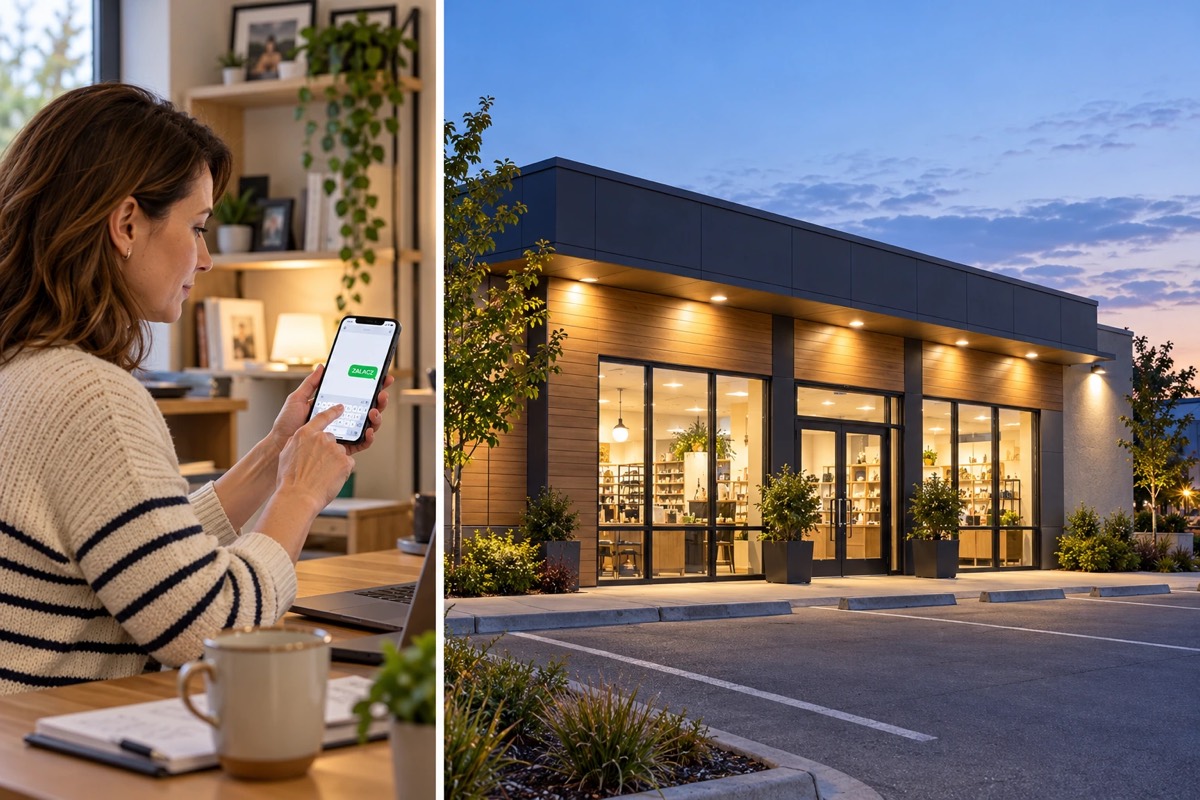
GSM controllers at the lamps of several sites: a “switch on” or “switch off” command sent from a mobile phone switches the lighting even when the site is closed and no staff are present.
01 / Investment context
The business owner runs several retail outlets and administrative premises and needs to control their outdoor lighting remotely — especially in summer, when the lamps are switched on at, for example, 20:00 and switched off before opening, for example at 6:00. Both times the site is closed and there are no staff who could switch the lighting on.
Every switching operation therefore needs either someone on site or a device that does it without staff. With several sites, a trip made only to switch the lamps on or off is repeated at each of them, and the hours when lighting is needed change with the season and with the needs of the day.
The investor’s goal: Remote switching of the outdoor lighting at several sites from a mobile phone — whenever the need arises, including when the site is closed.
GSM controllers at the sites’ lamps receive commands from a mobile phone. Their present-day equivalent is the two-channel LTE controller (GSU-K02/L), which switches its outputs on receiving a text message. The controller’s output drives a contactor in the lamp’s supply circuit — the controller’s relay only switches the contactor coil, and the contactor switches the lamp on and off.
When the need arises, a “switch on” or “switch off” command is sent from a phone to the number of the controller at the chosen lamp. Each controller has its own number, so where the lighting changes follows from the number the command is sent to. The commands are separate — “switch on” always switches on, “switch off” always switches off — so a repeated command does not reverse the state, as toggling with a single button would.
The controller needs no radio range, only mobile network coverage, so the distance between the phone and the site does not matter.
02 / Operating principle
A “switch on” or “switch off” command from a mobile phone switches the outdoor lighting, even at a closed site.
01 / Signal source
Phone From anywhereA “switch on” or “switch off” command to the number of the chosen lamp’s controller.
02 / Reception
GSU-K02/L GSM controller at the lampReceives the command and switches its output.
03 / Action
Lighting Contactor in the lamp circuitThe contactor switches the lamp on or off.
One site can be lit while another stays dark. Each controller has its own number, and “switch on” and “switch off” are separate commands — a repeated command does not reverse the state.
A simplified functional diagram.
03 / Installation components
The models used in the project, with their equivalents in the current range.
GSM controller at the lamp — today’s LTE version of the GSU-K02 used in this project. Two channels, LTE: the output drives a contactor in the lamp’s supply circuit.
Quantity: 1 per lamp
Part of the site’s electrical installation: it switches the lamp’s supply, and its coil is driven by the GSM controller’s output.
Quantity: 1 per lamp
Catalogue figures describe a device under stated conditions, usually in open terrain, and are not a guaranteed range in every installation. Device quantities in the examples are indicative.
04 / Value for the investor
The lighting of a closed site is switched on and off from a phone — without driving there and without waiting for someone to turn up at the site.
The lighting runs during the hours when it is needed, including unusual ones — without sending anyone to the site just to switch it on or off.
Each lamp has its own controller with its own number, so the lighting at one site can be switched on while another stays off — depending on the needs of the day.
05 / Before installation
Before devices are chosen, what matters is the site’s conditions and how the system ties into the final installation.
Source: an archived GORKE description of the installation. For a new investment we choose current models.
More from this sector
Retail and services
A wholesale market on two storeys: an alarm from any of 270 stalls reaches the guard room and the patrol’s pagers with the stall number, with an event log and a text message.
Retail and services
A filling station with two tills: the cashier calls for support with a button under the counter or by foot, the back office sees the till number, and an SMS reaches the regional manager.
Retail and services
A self-service car wash with 6 bays: a button at each bay’s terminal, a text message to the owner, and a receiver that shows the number of the bay where the customer is waiting.
A project for your site
Send us the key requirements — GORKE will help define the scope, the technology and the components that fit the investment.