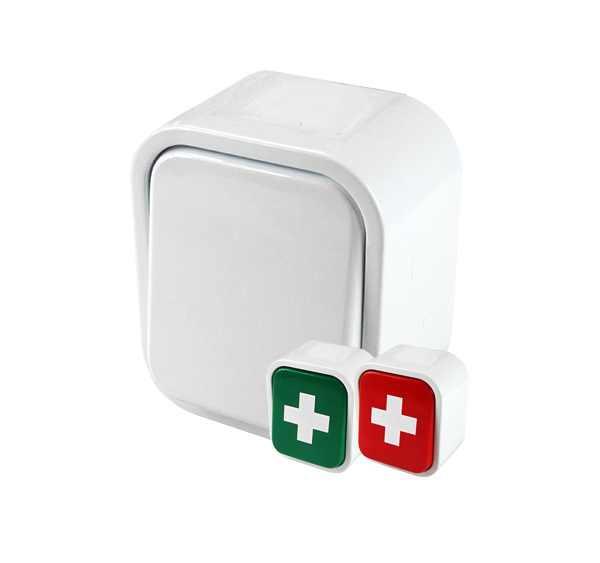
PNH-201
Sealed battery button at the gate, under a canopy, with a sign for the driver. Range up to 400 m in open terrain with receivers fitted with an H2 module.
Quantity: 1
A call point at the construction site gate: a battery button for the driver, pagers for the site manager and the storekeeper, and a lamp on the site office container — a set that moves on to the next site.
01 / Investment context
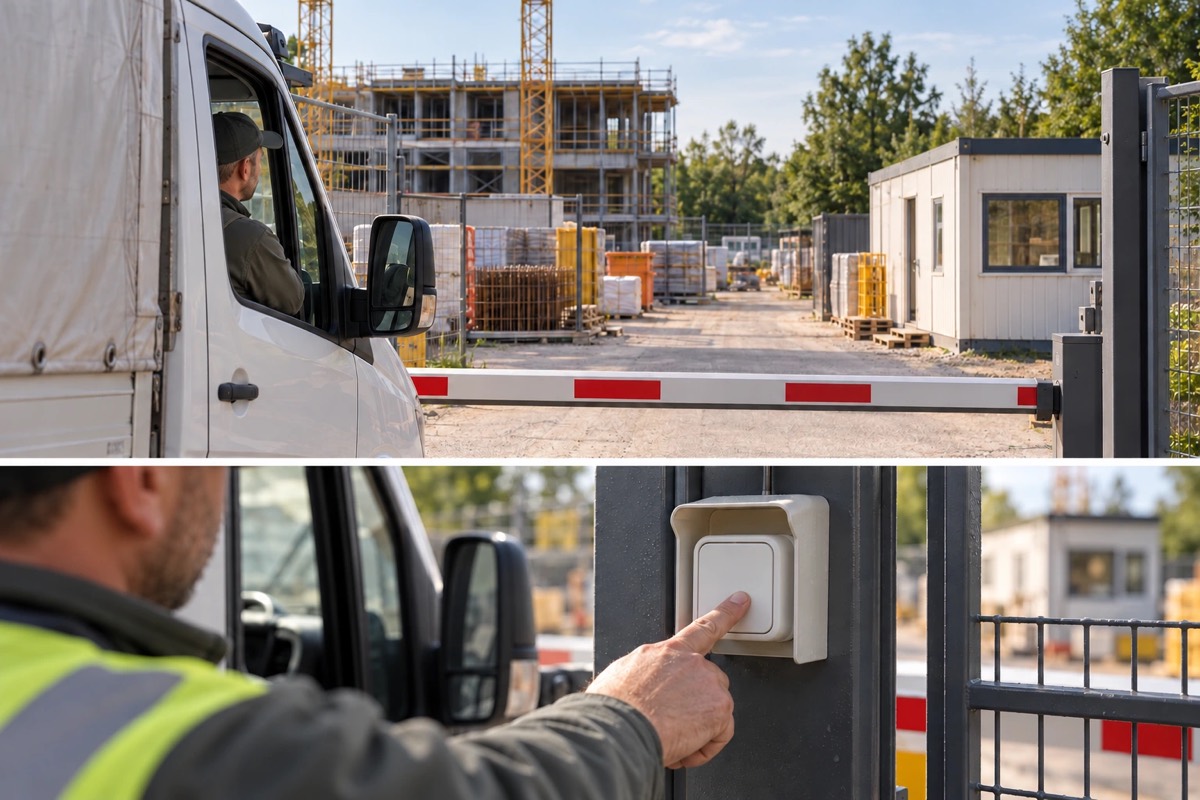
The construction site has one entrance gate, and the site manager’s office container stands 150 m further in. Deliveries arrive during the day, often from carriers who are here for the first time. The driver stops at a closed gate and does not know whom to call.
That leaves two options: phone the site manager, whose number the driver usually does not have, or walk onto the site and look for the manager among machines and scaffolding. The first delays unloading, the second is dangerous — someone without a safety briefing, and often without protective equipment, is walking around the site. The site manager, in turn, may be on an upper storey or at the far end of the site and cannot see that someone is waiting at the gate.
The investor’s goal: The driver calls for staff with one button and waits at the gate; the site manager or storekeeper knows about the delivery at once, wherever they are on site.
At the gate, under a small canopy, hangs a sealed battery button (PNH-201) with a sign: “Delivery — press and wait”. Its radio signal is received at the same time by the pagers of the site manager and the storekeeper (OBI-4SH) — so they learn about the delivery even at the far end of the site — and by a lamp on the container wall (BSO-2H2), visible to people in and around the site office.
The lamp stays on until someone takes the delivery: the site manager or the storekeeper switches it off with their remote (PUK-101) on the way to the gate, so everyone can see that someone is already dealing with it. The lamp is powered by a mains power supply (SPR-ZS1) inside the container; the button and remotes run on batteries, and the pagers are charged in the container.
A distance of 150 m is within the button’s open-field range, but a building in its shell stage dampens the signal. If the range test shows that the call does not reliably reach the pagers on the upper storeys, a repeater (RTS-1000) on the container carries it. When the job is finished, the button, lamp and power supply are taken down and moved to the next site.
02 / Operating principle
A button at the gate calls the site manager and the storekeeper on their pagers and lights a lamp on the container 150 m away.
01 / Signal source
PNH-201 Button at the gateThe driver presses and waits at the gate.
02 / Transmission
Radio signal To the pagers and the lamp at onceNo cables across the site; if the range test calls for it, an RTS-1000 carries it.
03 / Notification
Staff Site manager and storekeeper Pagers + LampThe call on the pagers, and a lamp lit on the container wall.
The driver waits at the gate instead of walking the site. The lamp stays on until the site manager or the storekeeper switches it off with a remote — everyone can see someone is dealing with the delivery.
A simplified functional diagram.
03 / Installation components
An example selection — the number of devices depends on the site.
Sealed battery button at the gate, under a canopy, with a sign for the driver. Range up to 400 m in open terrain with receivers fitted with an H2 module.
Quantity: 1
Pager for the site manager and the storekeeper: the call from the gate reaches them wherever they are. Charged by USB or wirelessly.
Quantity: 2
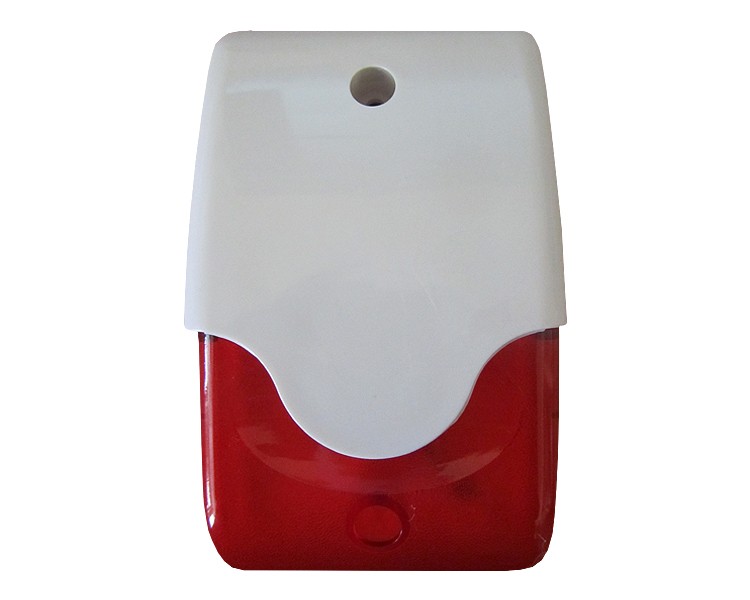
Signal lamp on the container wall, H2 module: the gate button switches it on, the site manager’s or storekeeper’s remote switches it off.
Quantity: 1
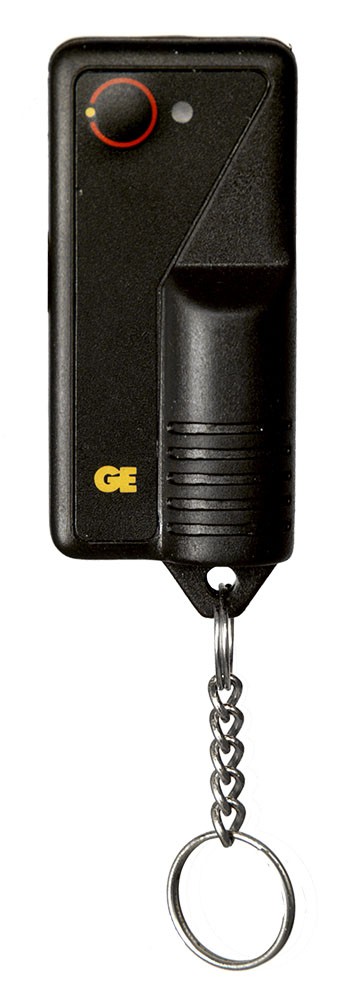
One-button remote for the site manager and the storekeeper: switches off the lamp on the container when someone goes to the gate for the delivery.
Quantity: 2
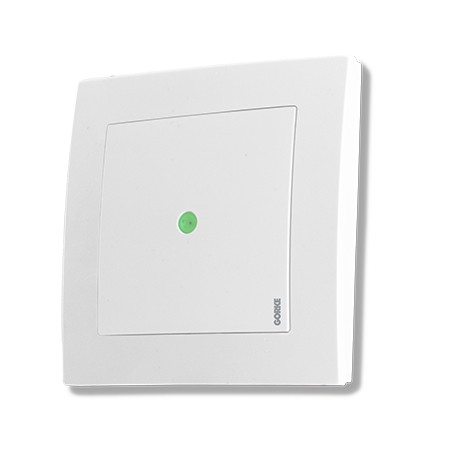
A 230 V AC power supply inside the container: it powers the lamp on the container wall and, if needed, the repeater as well.
Quantity: 1
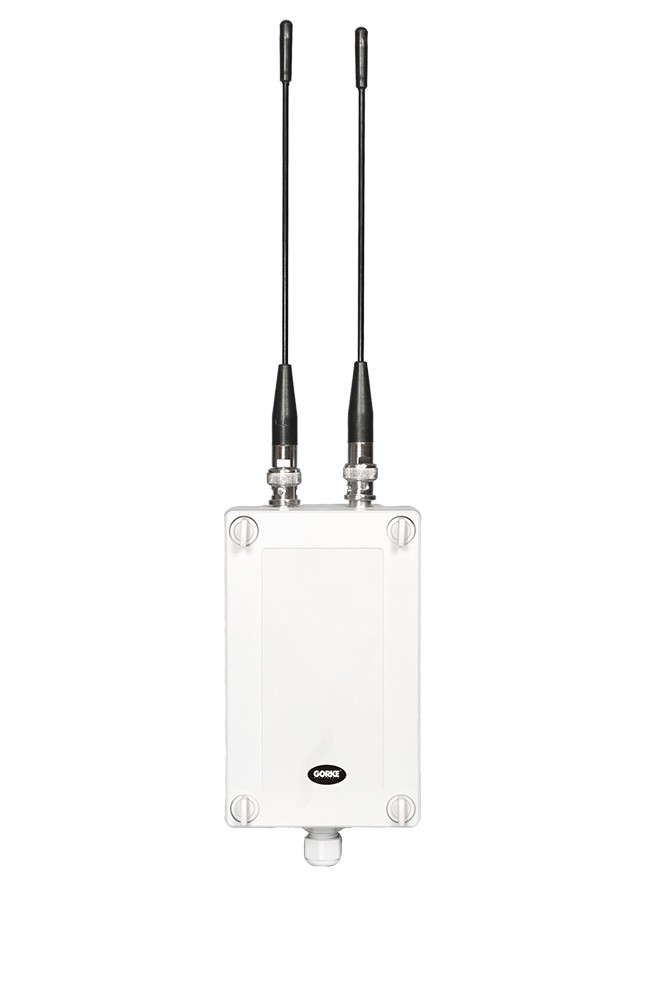
Repeater on the container if the range test calls for it — it carries the call from the gate to the pagers inside the building.
Quantity: optional
Catalogue figures describe a device under stated conditions, usually in open terrain, and are not a guaranteed range in every installation. Device quantities in the examples are indicative.
04 / Value for the investor
The driver waits at the gate until someone comes, so no one without a safety briefing and protective equipment appears on site.
The site manager or storekeeper knows about the delivery at once, even from the far end of the site, not only when the driver finds someone.
The button, lamp, power supply and pagers move with the company to the next project — no cables left behind on site.
05 / Before installation
Before devices are chosen, what matters is the site’s conditions and how the system ties into the final installation.
Example configuration — it needs a technical selection for your site.
More from this sector
Construction
SKANSKA: LX transmitters on the storeys of a high-rise under construction tell the goods-hoist operator where the call comes from — and the system grows with the building.
A project for your site
Send us the key requirements — GORKE will help define the scope, the technology and the components that fit the investment.